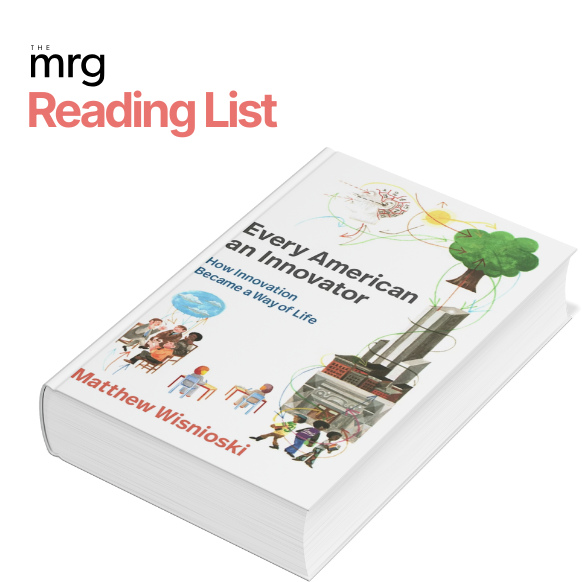
Reading List Recommendation
Since the early 2000s it seems like the word and concept innovation has been everywhere. In job descriptions, product summaries, company profiles and more, innovation has been a hiring criteria, a point of personal credibility and an aspiration for people, educational programs and businesses.
But why? How did innovation become such a central feature of professional, academic and personal life?
The book Every American an Innovator: How Innovation Became a Way of Life by Matthew Wisnioski seeks to answer this question through a detailed history and, ultimately, offers a moderated critique of American innovation culture. The book is a good read for students of business, entrepreneurs and anyone interested in pop, business and social history as it charts the evolution of the post-WWII and Cold War technology, global competitive advantage and growth booms, maps local and national policy enablers of innovation and offers a deep reading list for those looking to dig into the historical sources he references.
One of the most relevant contributions of the book to today’s moment is Wisnioski’s outline of how the Boston corridor, Pittsburgh and Silicon Valley regional innovation centers developed, paving the way for the tech and startup rockstar phenomenon we know so well today. Most importantly, Every American is an essential read for innovation practitioners, to help understand the many phases and formats innovation work has taken in the past and to understand the fair criticisms of that work in order to optimize it for the future. From demystifying the origin stories of traditional approaches like design thinking and tech-dominated innovation practices to crisp syntheses and reading lists on newer developments like social innovation, maintaining, responsible innovation, inclusive innovation and design justice, the book serves as a practical handbook to the many pathways that innovation work can take.
This book is an essential read for innovation practitioners.
Critically, these alternative intellectual and professional movements challenge innovation’s often inherent notions of continuous growth, singular expertise and individual responsibility for solving systemic problems. As an innovation practitioner that leverages multiple approaches from many disciplines, The Margin Release Group sees innovation as something to be defined by each and every organization based on their objectives, the team they are working with and the context they are working within. That is why we employ many approaches from traditional to alternative and we welcome critical examination of our practices. Innovation practitioners must also innovate in order to offer clients the best outcomes. Now that sounds like a line right out of an old-school innovation propaganda reel, doesn’t it!
Pick up Every American an Innovator: How Innovation Became a Way of Life and check out these five surprising insights from the book.
1. Today’s innovation culture began developing back in the 1950s and 1960s.
Encouraged by government policy and incentives, educational and research collaboration, think tank guidance and the broad expansion in business and government technology output to deliver American economic growth.
2. There is evidence innovation practice often leads to imitation instead.
This is what’s called the innovation deficit model. Other critics from the maintainers, responsible innovation and design justice communities say innovation culture and practice excludes marginalized groups and reinforces unsustainable indefinite growth.
3. There is a name for the distinctly American approach to public-private partnerships in education, technology and business: creative federalism.
The book carefully explores the history of this partnership structure and its benefits and challenges. This is increasingly relevant as current federal policies and actions begin to erode this historical approach.
4. Many Presidents championed innovation in direct ways.
Nixon, Carter, Reagan and Clinton, to name a few, encouraged innovation through policy, awards and medals, special reports, cabinet or advisor roles and commissions, with a variety of end goals. Sometimes innovation was a code-word for self-empowerment in parallel with public assistance reductions, sometimes innovation was used to promote scientific experimentation and sometimes to help drive economic vitality in communities.
5. Museums have also had a direct role in promoting innovation culture.
Among the most high-impact approaches was the Smithsonian Institute’s 1995 partnership with the Lemelson Foundation, at the time the largest single donation the museum network had received. Lemelson sought to explicitly embed the spirit and action of invention and innovation throughout society, with museums and exhibitions as a key conduit to children within their ‘pyramid’ strategy for cultivating innovation in all life stages.