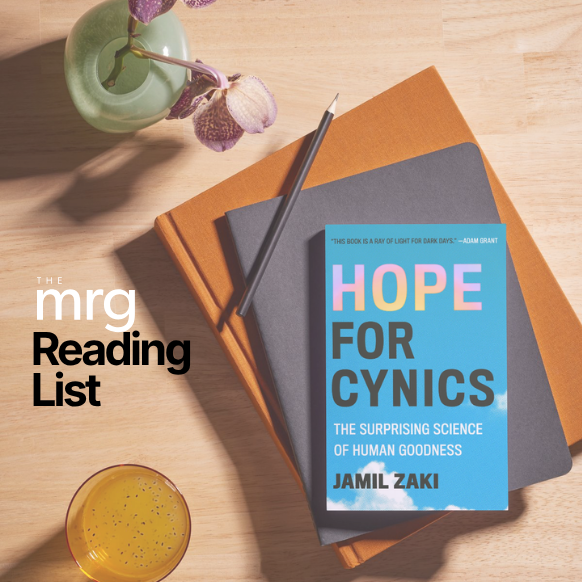
If you’re a cynic, it’s hard to imagine a more eye-roll-inducing title for a book than this one. And maybe that’s part of the point.
Hope for Cynics: The Surprising Science of Human Goodness, Jamil Zaki
Turns out this book is more than a couple hundred pages of hollow self-help tropes or sweeping brushes of protracted positivity. Hope for Cynics: The Surprising Science of Human Goodness by Stanford University’s Dr. Jamil Zaki offers data he says proves that cynicism is unhealthy and ineffective and proposes a set of concrete approaches for weaving an alternative to cynicism into day-to-day life. These ideas could be powerful for individuals and transformational for teams.
What is cynicism, exactly?
Cynicism assumes that people are inherently selfish, greedy and dishonest and then believing and acting based on this worldview. Zaki points out that cynicism is often confused for skepticism but that the difference between the two concepts is significant. Where cynics presume the worst, skeptics allow their beliefs and actions to be guided by the data people offer them: for better or worse.
One of Zaki’s biggest contributions through this book may be in refuting this assumption. Using data from his social neuroscience lab at Stanford University and other sources Zaki sets out to prove that cynics are not smarter, safer and better judges of people and situations than the rest of us. Hope’s data suggests that cynics may:
- Score less well on cognitive ability tests
- Be less effective at spotting liars in trust-based tests
- Earn less in trust-based investment games
- Accumulate less lifetime earnings
- Have higher incidences of heart disease
- Are more likely to be depressed and become alcoholic
But isn’t it just smart to be a cynic in this crazy world?
Why? Because thinking the worst about others leads us to withhold trust, take fewer calculated risks, find positive outlets and opportunities and lean on others for support when needed, leading to less beneficial outcomes across personal and professional life.
Cynicism is contagious, but perhaps not real
According to Zaki, 79 percent of people think other people do not trust enough and 80 percent believe our society is too divided. Yet, his and other studies from Pew, Edelman and others suggest trust of fellow humans, institutions, the wealthy, governments and media are at all-time lows in the United States and globally.
Zaki’s data explains this devastating and ironic contradiction: most people believe themselves to be more trustworthy, generous and open-minded than they give other people credit for. And negativity travels fast and far, especially with media to boost it.
What if we could extend the benefit of the doubt beyond ourselves to more people we meet and interact with?
Try skepticism, instead
Hope for Cynics acknowledges that hope itself has developed a cringe-worthy public reputation. Hope is for the gullible, for the inexperienced, for the rose-colored idiots and is a tool of delusional dreamers, not the real world, right?
As an alternative, Zaki suggests hopeful skepticism – the willingness to be curious, to allow information to come in and then to craft beliefs and actions based on how people actually engage us rather than how we expect them to act.
He offers some practical suggestions on how to unlearn cynicism and begin to practice hopeful skepticism, like:
- Reciprocal mindset: actively mirroring the investment or withdrawal others show you
- Loud trust: proactively giving people a first leap of faith, pivoting when their actions no longer indicate trust is warranted
- Encounter counting: keeping a list of how many people interactions you have every day and recording when others treated you well and poorly
- Attempt projects and processes as collaboration instead of competition
- When in a disagreement, intentionally name 2 areas of common ground
- When facing problems, actively identify a solution for every complaint
- Call in those we don’t agree with versus call them out for their perspective
- Naming those huge systemic problems that enable us to retreat to cynical complacency
What might organizations learn?
While they may not on their own solve the most gnarly systemic challenges facing us, Zaki’s ideas could have significant impact on individual relationships and over time on larger communities. Practiced with intention across organizations, Zaki’s hopeful skepticism could serve as a transformational cultural value and behavioral expectation.
Why not ask:
- Could reciprocal mindset help siloed orgs find more common ground for teamwork across functions and stakeholders?
- Might developing a calling in practice help misaligned employees find purpose with the team mission rather than isolating outliers who disagree?
- Could loud trust become an organizational value that helps teams maximize outcomes and minimize divisive internal politics and inefficient bureaucracy?
There is no exact blueprint, but Hope for Cynics provides concrete ideas for improving how humans engage each other.
To manage and succeed in today’s volatile environment, mission-driven organizations must harness the most capable, healthy, engaged and effective teams they can. Zaki’s ideas offer meaningful ideas and tools to help teams be their best and achieve high, through the power of strategic hope and relationship.
Check out how The Margin Release Group can help your team engage dialogue and innovation-based mindsets and tools to strengthen culture and weave hopeful innovation into day-to-day work.
Learn more
Check out the book Hope for Cynics: The Surprising Science of Human Goodness.